Normal Accidents and Root Cause Analysis: Difference between revisions
No edit summary |
No edit summary |
||
| Line 12: | Line 12: | ||
Normal accidents: | Normal accidents: | ||
* 3 Mile Island Accident - Blamed Operators | |||
* Any system can and will fail, and you should plan for it to fail | |||
* 2 Axis graph | |||
** Complexity -> Simple | |||
** Loose Coupling -> Tight Coupling | |||
** Complex & Tightly Coupled = Accident | |||
* Complex system that is Loosely coupled is the CITCON open space set up evening | |||
** We did not all rush to get food and beer | |||
* E.g had there been a Lion in there, 1 person could have warned rest | |||
* Chance to warn of danger | |||
* Simple but tightly coupled = Dam | |||
** Accident is water gets through the damn | |||
** Anything goes wrong with dam e.g. hole, no chance to resolve | |||
** Simple to reason about, wall of rock with a hole in | |||
** But is high risk | |||
* In nuclear plant accident, cooling system near radioactive rods | |||
** Operators can see there was a leak, but no context e.g. they can see the leak is leaking near/into the radioactive rod storage which would lead to an accident | |||
* Book to Read: Normal Accidents by Perrow | |||
* Are micro services tightly coupled and complex? | |||
** Depends | |||
** It's down to design and implementation | |||
* Always strive to be in the bottom right corner of the graph, low complexity loosely coupled | |||
* How do people plan for failure? | |||
** Rob - We go through a certification process to get into Retail | |||
* Each system that could fail is tested, e.g. chaos monkey style someone will manually go take down services | |||
* Internal team will run same tests internally before handing over to external certification team | |||
How do you verify or even test your logging? Instance of a service that logged every time on failure, in a tight loop and filled the disks leading to further failure = Simple Tightly Coupled System | How do you verify or even test your logging? Instance of a service that logged every time on failure, in a tight loop and filled the disks leading to further failure = Simple Tightly Coupled System | ||
| Line 46: | Line 46: | ||
Scenario: Database deliberately down for maintenance. Instance of a service that logged every time on failure connecting to database, in a tight loop and filled the disks leading to further failure | Scenario: Database deliberately down for maintenance. Instance of a service that logged every time on failure connecting to database, in a tight loop and filled the disks leading to further failure | ||
* Basic principals | |||
** Everybody who was affected comes to the meeting | |||
* To identity cultural or people problems | |||
* Not allowed to place blame | |||
* Ask/poll everyone what was the problem | |||
** Customer: | |||
*** No system, was down, can't log on | |||
** Operations: | |||
*** Confused by phone call | |||
** Customer Service: | |||
*** Angry calls from customers, did not know what was going on | |||
** Developer: | |||
*** Database down, no disk space | |||
*** Then ask why: | |||
** Customer: | |||
** Operations: | |||
** Customer Service: | |||
** Developer: | |||
· Why: Maintenance on database, database down | · Why: Maintenance on database, database down | ||
· Why: Analysed log files, saw huge files, checked code, logged with no delay | · Why: Analysed log files, saw huge files, checked code, logged with no delay | ||
Revision as of 02:58, 21 September 2014
Normal Accidents book: http://press.princeton.edu/titles/6596.html
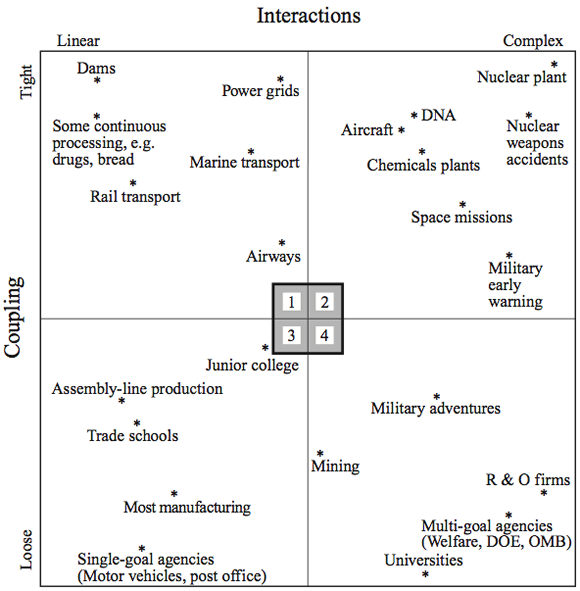
Systems are categorized by Interactions that are Simple vs Complex, and Tightly Coupled vs Loosely Coupled.
There are a few different versions of the quadrant: http://paei.wdfiles.com/local--files/perrow-charles-normal-accident-theory/PAEI_043_Perrow_Normal_Accident_Theory.gif https://www.flickr.com/photos/metanick/139214026/ http://media.peakprosperity.com/images/3-Perrow-from-Accidents-Normal.png
Douglas Squirrel talking about root-cause analysis: https://skillsmatter.com/skillscasts/1986-talk-by-squirrel
Notes on Squirrel's talk: http://www.markhneedham.com/blog/2011/12/10/the-5-whysroot-cause-analysis-douglas-squirrel/
Notes from John Bradshaw:
Normal accidents:
- 3 Mile Island Accident - Blamed Operators
- Any system can and will fail, and you should plan for it to fail
- 2 Axis graph
- Complexity -> Simple
- Loose Coupling -> Tight Coupling
- Complex & Tightly Coupled = Accident
- Complex system that is Loosely coupled is the CITCON open space set up evening
- We did not all rush to get food and beer
- E.g had there been a Lion in there, 1 person could have warned rest
- Chance to warn of danger
- Simple but tightly coupled = Dam
- Accident is water gets through the damn
- Anything goes wrong with dam e.g. hole, no chance to resolve
- Simple to reason about, wall of rock with a hole in
- But is high risk
- In nuclear plant accident, cooling system near radioactive rods
- Operators can see there was a leak, but no context e.g. they can see the leak is leaking near/into the radioactive rod storage which would lead to an accident
- Book to Read: Normal Accidents by Perrow
- Are micro services tightly coupled and complex?
- Depends
- It's down to design and implementation
- Always strive to be in the bottom right corner of the graph, low complexity loosely coupled
- How do people plan for failure?
- Rob - We go through a certification process to get into Retail
- Each system that could fail is tested, e.g. chaos monkey style someone will manually go take down services
- Internal team will run same tests internally before handing over to external certification team
How do you verify or even test your logging? Instance of a service that logged every time on failure, in a tight loop and filled the disks leading to further failure = Simple Tightly Coupled System
Root Cause Analysis
Scenario: Database deliberately down for maintenance. Instance of a service that logged every time on failure connecting to database, in a tight loop and filled the disks leading to further failure
- Basic principals
- Everybody who was affected comes to the meeting
- To identity cultural or people problems
- Not allowed to place blame
- Ask/poll everyone what was the problem
- Customer:
- No system, was down, can't log on
- Operations:
- Confused by phone call
- Customer Service:
- Angry calls from customers, did not know what was going on
- Developer:
- Database down, no disk space
- Then ask why:
- Customer:
- Operations:
- Customer Service:
- Developer:
- Customer:
· Why: Maintenance on database, database down · Why: Analysed log files, saw huge files, checked code, logged with no delay · Why: Developer skills lacking · Why: No code review/inspection · Why: Test for this logging case lacking · When QA tested database was running · QA too busy to investigate database failures cases · No new blood in organisation · QA assigned/overbooked to too many projects · Action: Maintenance on DB, have redundant database to switch to · Action: QA involved earlier
§ Actions must be assigned and completed with a timeframe e.g. 1 week § When you hit that uncomfortable silence half way down, keep pushing
· The root cause of failure is always the culture in an organisation
o It’s always about people e.g.
· The developer adding no delay to logging
· Lack of testing
· Create a RCA timeline of failure
o At what time did system go down
o At what time did customers complain
o At what time did developers react
o At what time was the system back up
o Etc
· Do as much technical investigation as possible before the RCA meeting
o Eg this was the problem
o We had these tests
· But we didn’t have one for this scenario